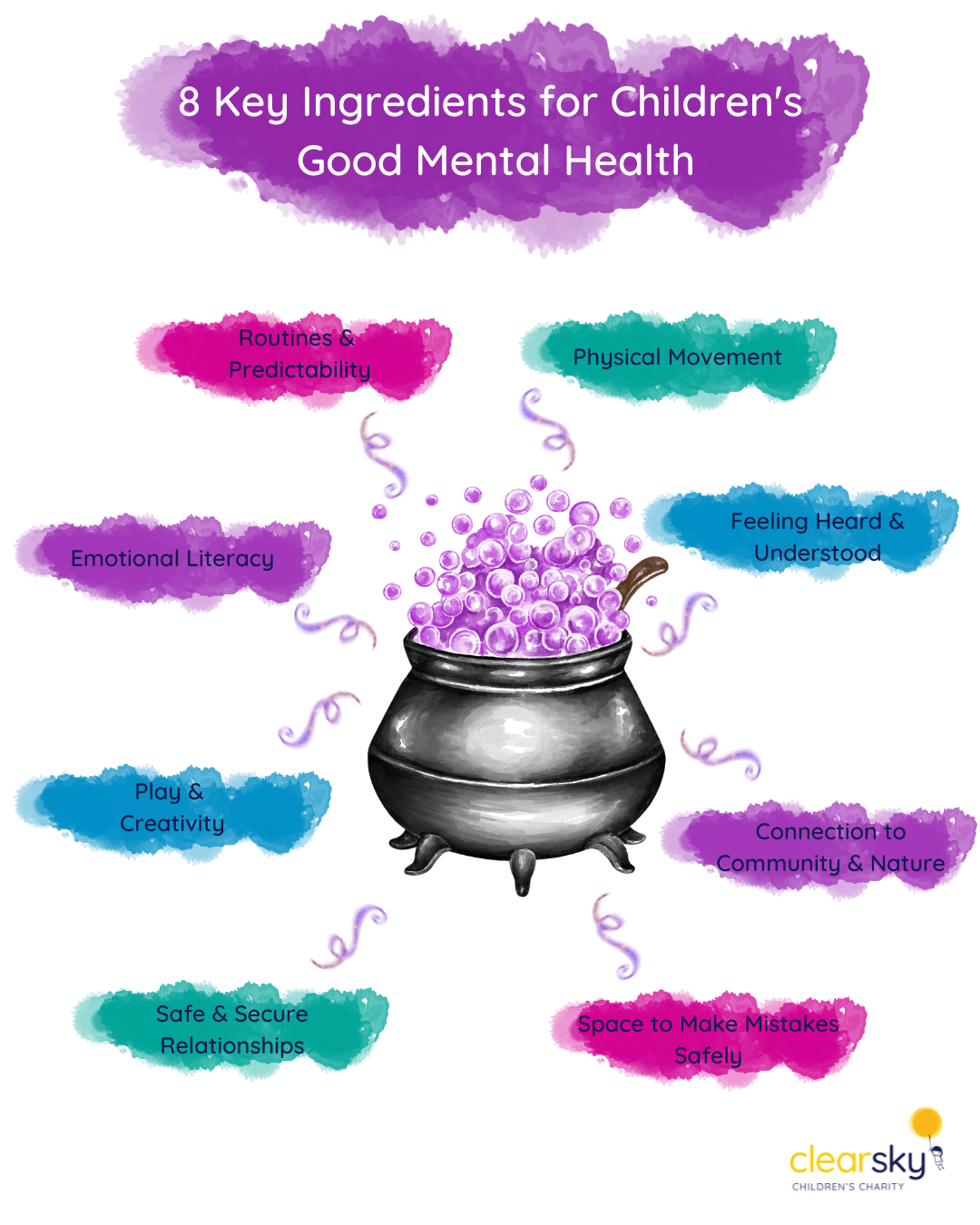
It's Children's Mental Health Week and we've been thinking about what children need in order to thrive.
Children's mental health is made up of many elements - read on to explore 8 ingredients we believe all children need to thrive 🪄
Safe & Secure Relationships
A child who feels well supported knows “I'm okay, and if I'm not okay, someone will help me.” This felt sense of security is a hugely protective factor, supporting them to:
- Explore and learn with confidence
- Manage relationships effectively
- Recover from setbacks
- Focus on learning rather than seeking connection
- Build healthy relationships throughout life
What this can look like: A caregiver who shows up consistently, repairs after conflict, and helps a child feel seen and valued. A reminder that as caregivers/ school staff we to can provide those important relationships for young people.
Play & Creativity
Play is the natural language of childhood. It's how children communicate and make sense of their world before they have the words to express complex thoughts and feelings.
Through play, children
- Make sense of experiences
- Develop problem solving skills
- Build confidence and resilience
- Express what they don't yet have words for
- Develop their capacity for empathy
What this can look like: Unstructured time to imaginatively play, creative arts, storytelling, building, making and exploring, and importantly, 1:1 play times with emotionally available adults.
Emotional Literacy
When we can name or label an emotion, we are better equipped to manage, feel and process it. Emotional literacy - the ability to identify, understand and express emotions - is a hugely protective factor for children's long term mental health.
What this can look like: Adults naming emotions openly, validating feelings without rushing to fix them, greeting feelings with empathy, and giving children the language and space to express their inner world without judgement.
Routines & Predictability
For children, particularly those who have experienced uncertainty or trauma, predictability is safety. Knowing what comes next calms the nervous system, reduces anxiety and allows children to relax into learning, connection and play.
What this can look like: Consistent daily rhythms, clear and gentle boundaries, recognising triggers for children who have experienced trauma, being a predictable adult when it comes to behaviour management.
Physical Movement
Movement and mental health are deeply connected. Physical activity releases chemicals like dopamine, serotonin and endorphins, and these chemicals naturally regulate mood. Movement helps children discharge stress, improves sleep, and helps them to build strong and resilient bodies.
A bonus is that physical play like hopping, skipping, throwing and catching support the connection between the right and left hemispheres of the brain! This connection is vital in supporting the development of academic skills (like reading and writing, and math!).
What this can look like: Active play, like climbing, dancing, sport, walking in nature, or simply having space to run and move freely.
Feeling Heard & Understood
One of the most powerful things we can offer a child is the experience of being truly listened to. When children feel heard, they feel valued. This builds self-worth, strengthens relationships and teaches children that they really matter.
What this can look like: Getting down to a child's level, following their lead in conversation, resisting the urge to immediately advise or fix, and reflecting back what you hear.
Connection to Community or Nature
We all thrive when we feel we are a part of something. Whether that's a family, a friendship group, a school community or time connecting with nature. A sense of belonging is vital for good mental health.
What this can look like: Allowing children to meaningfully contribute in school - through group projects or creations, or by simply having a small role in the classroom like handing the books out. Recognising and embracing diversity, sharing community rituals and celebrations, time outdoors (forest school!),
Space to Make Mistakes Safely
Children learn who they are through trial and error. When mistakes are met with curiosity rather than criticism, children develop resilience, self-compassion and a growth mindset. They learn that getting things wrong is part of being human, allowing them to take risks and reach their full potential.
What this can look like: Adults modelling their own mistakes openly, responding to children's errors with warmth and curiosity, and celebrating effort over outcome.
What would you add?

Responses